

In case you missed the last issue, you can find it here.
This issue:
We Need to Talk About Mr. Pibb: How a little known soda blew up so quickly
The Fight for Fall: Why isn’t Pumpkin Spice Dead Yet?
We Are Post-Meal Kit Now: What dinner means next
Gut Reaction: My quick thoughts on the newest launches
TidBits: The latest in F&B and business news
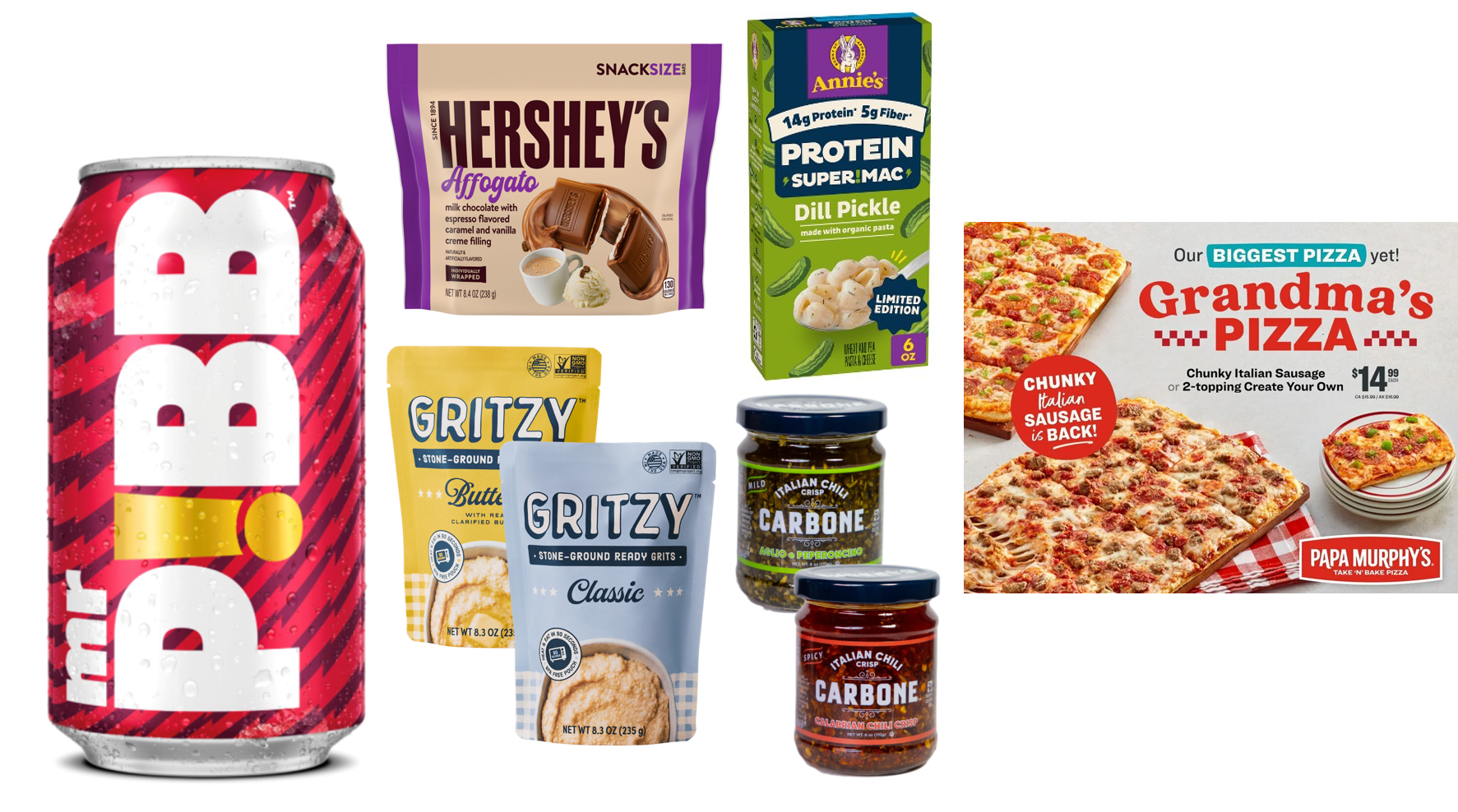
Products: Mr Pibb; Gritzy; Hershey’s Affogato; Annie’s Protein SuperMac Dill Pickle; Carbone Italian Chili Crisp; Papa Murphy’s Grandma’s Pizza;
We Need to Talk About Mr. Pibb
Morning Consult recently published their Fastest Growing Brands 2026 survey with this opener: “2026 was a tough year for brand growth. Just 14% of brands saw growth in purchase consideration in 2026 — a five-year low in our tracking.” In 2025, 94% of brands saw purchase consideration grow, this year 86% saw purchasing consideration hold flat or decline.
But do you know what brand grew the most? Mr. Pibb.
Mr. F***** Pibb! A soda most people couldn’t find on a shelf two years ago, had the largest purchase consideration gain (+11.2) of any brand, topping 9 of 12 audience segments. It beat every tech brand, every CPG giant, and every new entrant. The second-place brand, Jimmy Dean, came in at less than half that number.
Now, I can come up with lots of tactical explanations: nostalgia, smart marketing with Roy Wood Jr., and distribution tailwinds from Coca-Cola pushing Pibb into fountain machines and shelf slots vacated by regional Dr Pepper bottling realignments. All are real factors, but none of them, individually or together, explain why a (let’s face it) C-tier soda outperformed the entire American brand landscape by that margin.
Let me try to explain what I think is happening here. Mr. Pibb had a massive cultural float.
In banking and finance, a float is the time and value gap between when a transaction begins and when the funds fully settle (i.e., deposit check vs. check clears). In the recent past, moving physical checks created multi-day delays that gave payers an interest-free window of credit. Electronic payment methods today have significantly compressed those timelines, but floats have far from disappeared. In fact, understanding the short-term float is still a major source of interest income in modern finance.
What I’m suggesting is that Mr. Pibb had a significant float: a large gap between how much the brand existed in culture (Reddit threads, social media mythology, “obscure soda knowledge” as social currency, active online conversations about its mystique) and how much it existed in commerce (thin distribution, rebadged as “Pibb Xtra,” functionally unavailable to most consumers). The relaunch collapsed that gap. Twenty-four years of accumulated cultural energy converted into purchasing behavior in a matter of months. The result was that massive release of stored demand (i.e., that +11.2pts in purchase consideration).
The old CPG model assumed commerce led culture. You made a product, distributed it, advertised it, and cultural presence (if it came) followed as a downstream effect of commercial success. But today that sequence has inverted. Social media, food media, TikTok, and the general speed of cultural information means that consumer desire for a flavor, format, or experience now routinely reaches massive scale before any commercial infrastructure exists to serve it (the tail wags the dog).
People want things before they can buy them, and that wanting is visible and measurable in ways it never was before. In other words, that float accumulates in public. The result: larger gaps, longer lags between cultural awareness and commercial availability, and bigger conversion events when someone finally collapse the stored demand.
Recent cultural floats:
· Dubai chocolate is the TikTok-speed version
· Grandma-style pizza (discussed in pizza subreddits and canonized online, like Detroit-style pizza before, it as a pizza style that hadn’t gotten enough respect)
· Pickle juice and pickle everything went from niche oddity to mass
· Regional southern foods like Gritzy or Chicken Salad Chick, taking much discussed but hard to find items and cashing in on them.
You know who understands cultural float really well? Trader Joe’s and Costco, but each in different ways.
Trader Joe’s has it down to a science. Everything bagel seasoning, ube, elote-flavored snacks: each was a case where a flavor or food experience had high cultural presence and low commercial accessibility, and TJ’s built an affordable, packaged version. They didn’t create demand, they just built the commercial pathway to capture demand that was already there.
Costco does a version of this at the quality-tier level: products like high-end olive oil and aged Parmigiano have cultural presence (food media, cooking shows, restaurant exposure) that far exceeds their commercial accessibility at mainstream price points. Costco closes that gap through Kirkland branding and bulk purchasing.
Even when consumers (like this year) are pulling back, if you cash in on that float, you can win. So, I’ve been challenging my clients: where in your category does cultural presence significantly exceed commercial presence right now? What are people talking about, posting about, performing identity through, going out of their way to access, that doesn’t have a corresponding product on a shelf at the right price in the right format? That gap is where your next outsized growth is sitting.
Are you reading Refraim Perspectives? If you’re serious about CPG, you really should be. Having worked alongside both David Clark and Peter McDonald, I can tell you firsthand that their strategic rigor and analytical thinking is top-tier. When they team up on an analysis, it is always worth paying attention.
Take a look at an excerpt from their excellent breakdown of the Barilla acquisition of Goodles:
Barilla Gets GOODLES: Why Private Strategics Keep Winning Growth Brands
Today’s breaking news: GOODLES has agreed to be acquired by Barilla. What does this acquisition have in common with other recent transactions like Purely Elizabeth (Ferrero), Kellanova (Mars), Daily Harvest (Chobani), and Power Crunch (Ferrero)?
All were purchased by privately owned CPG strategics. By our count, there have been about 38 Food CPG transactions by strategics over the past 5 years. From 2021 to 2023, 11 were public and 6 were private. From 2024 to today, 8 were public and 13 were private.
Why is this shift happening, and what does it mean?
The pattern cannot be explained by strategic fit alone. General Mills invested $3 million in Purely Elizabeth in 2017, yet Ferrero ultimately became the acquirer. Kraft Heinz and General Mills are the two leading players in U.S. boxed mac and cheese, yet the buyer for GOODLES was Barilla…
David and Peter break down the four financial forces combining to tilt the M&A landscape toward private buyers, from bond market yields to public dividend traps.
[Read the full analysis and subscribe to Refraim Perspectives here]
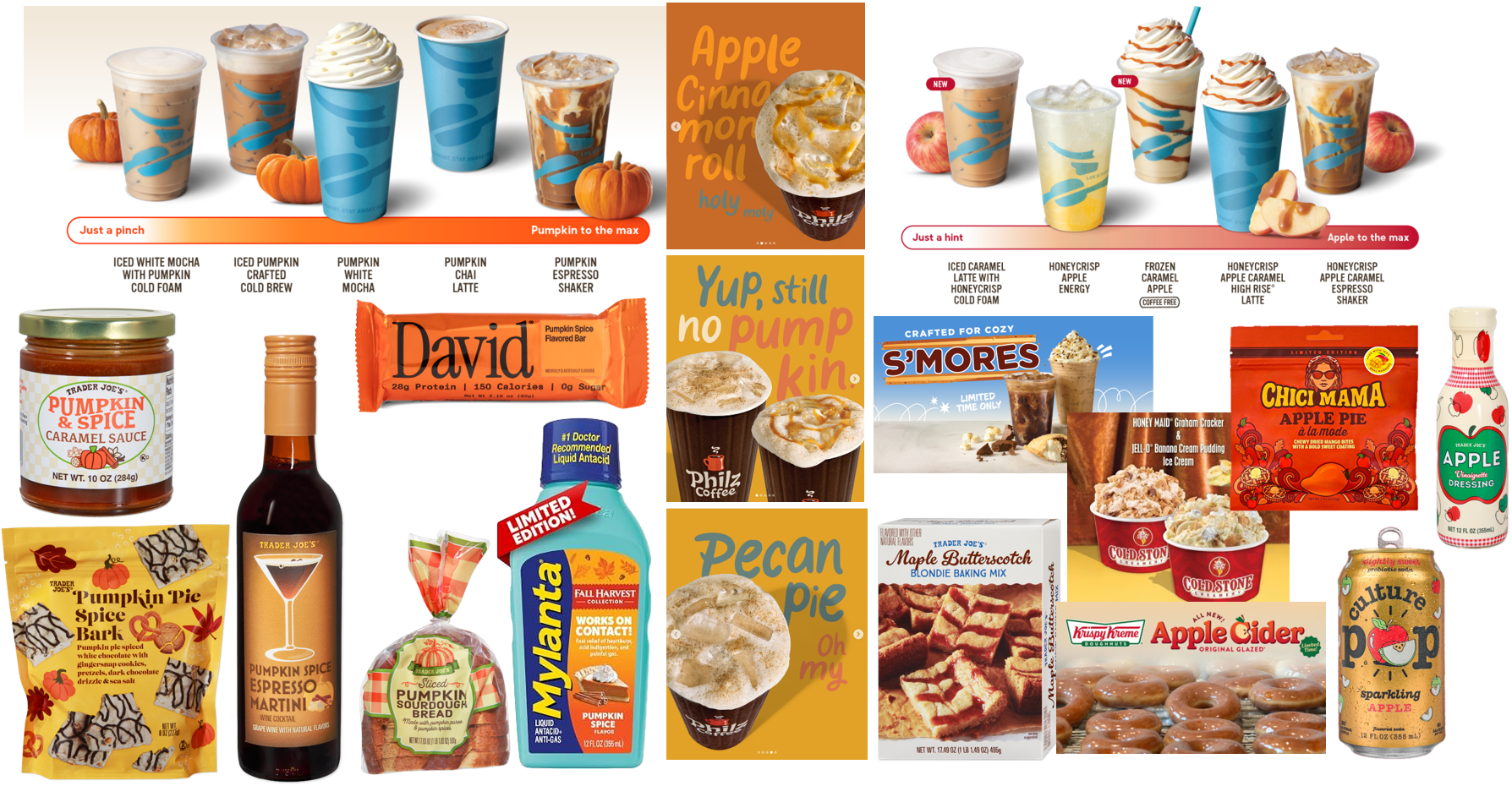
Products: Hardees S’mores platform; ColdStone Going Bananas for JELL-O® Pudding Creation™ and Crumb and Get It Creation™; Trader Joes Pumpkin & Spice Caramel Sauce; Trader Joes Maple Butterscotch Blondie Baking Mix; Trader Joes Apple Vinaigrette Dressing; Trader Joe’s Pumpkin Spice Espresso Martini; Trader Joe’s Pumpkin Sourdough Bread; Trader Joe’s Pumpkin Pie Spice Bark; Krispy Kreme Apple Cider Glazed Donuts; Culture Pop Sparkling Apple; Philz Coffee; Caribou Pumpkin Drink spectrum ; Caribou Coffee Apple Drink Spectrum; Mylanta Pumpkin Spice; Chici Mama Apple Pie a’la Mode mango bites
The Fight for Fall: Why isn’t Pumpkin Spice Dead Yet?
Yes, we’ve all heard the complaint that pumpkin spice season seems to get earlier and earlier every year. When it’s still sweltering in August, like clockwork, Starbucks rolls out their PSL lineup. Only Costco, with their Christmas displays in July, attracts more seasonal anger (and love).
However, this year I’ve noticed that more and more QSR and CPG companies are pushing back against pumpkin spice. Philz Coffee’s Instagram (above) says “Yup, still no pumpkin.” Mango snack brand Chici Mama, when introducing their new Apple Pie a’la Mode bites said, “Pumpkin spice has had fall in a chokehold long enough.” I’ve seen more maple, s’mores, brown butter, chai, apple, pecan, butterscotch, and banana bread variations this year than ever before. But the question is: will it work? Can pumpkin spice be displaced?
First, you must understand that pumpkin spice isn’t just a flavor. Starbucks took a nebulous cultural and sensory feeling and captured it in a drink. The brief window between Late September and Thanksgiving had never been crystalized before so succinctly in a flavor that you could consume so easily (versus the yearly slice of pie). Add to that the forced scarcity and social consumption (i.e., people posting online a picture of their first PSL of the season) and you get RITUAL.
It is very difficult to take down a ritual. You definitely can’t do it just with a new flavor, no matter how tasty. Maple is fine but it’s available on pancakes year-round (the same with brown butter, pecan, and banana bread). There is even an argument to be made that creating a new PSL-like phenomenon is nearly impossible today, that what Starbucks did was the last dying breath of mass consumerism before we splintered into our current siloed world.
I wouldn’t go that far, but I do believe what we’ll see next will be different. If I had to predict, I’d say the more likely outcome is that pumpkin spice slowly loses cultural energy without any single replacement capturing it. The fall season will fragment into three or four sub-moments rather than one monoculture. In fact, that’s already happening. You can see companies carving out “early fall” (apple, s’mores) versus “deep fall” (pumpkin, maple, brown butter) versus “holiday transition” (peppermint, gingerbread, ‘nog). The PSL doesn’t die, it just stops being the event and becomes one option among several.
If I had to pick one flavor that could challenge pumpkin spice, I’d choose apple (it looks like Caribou thinks so too, see above). It has all the cultural, seasonal, and sensorial cues. However, because apples are around most of the year, the flavor needs to be a unique apple spice or flavor that speaks to the season (like apple cobbler, roasted apple, spiced apple). Even then it would need a format and brand with enough power to turn it into a ritual. Net-net: don’t cash in your pumpkin spice stock just yet.
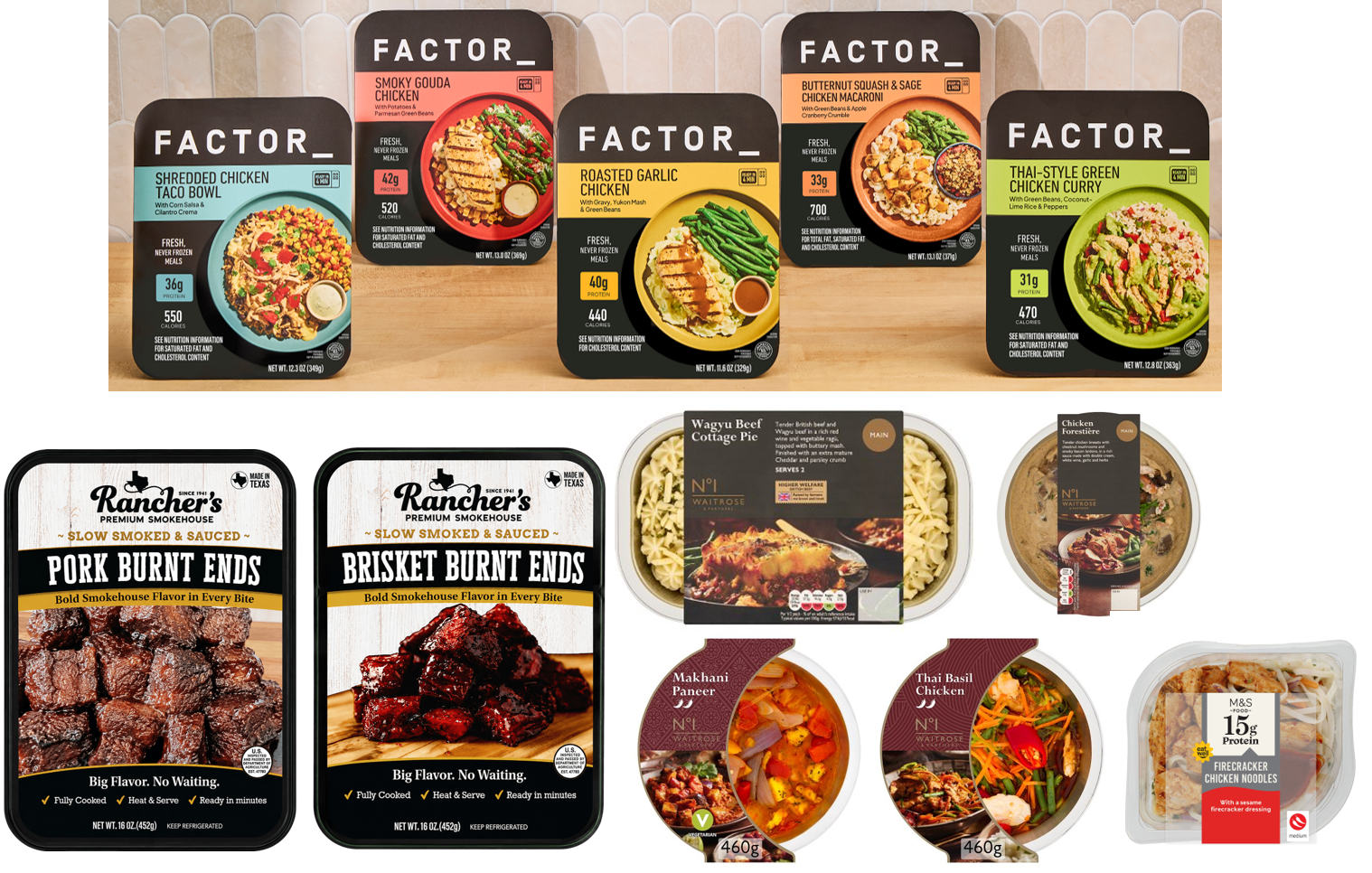
Products: Factor at Target; Ranchers Premium Burnt Ends; Waitrose Invests £10m in Premium Ready Meals; M&S Protein Meals
We Are Post-Meal Kit Now
Factor, the ready-to-heat (RTH) meal brand acquired by HelloFresh to hedge against slowing kit sales, is now rolling out into 800 Target stores across the US. The press release framed this as an ambitious “retail expansion,” but the strategic subtext is clear: the raw-ingredient subscription model that launched the category has hit a ceiling, and this a pivot to fully prepared, shelf-ready meals to survive.
If you look at Factor’s own parent company earnings, HelloFresh, the move makes sense. Group revenue fell 7.8% in Q2 2026 and meal kit revenue declined 8.9%. Order volumes dropped from 25.3 million to 21.8 million year over year. Management now talks about “revenue quality” instead of growth. That translates into loyalist customers with 50-plus lifetime orders accounting for 51% of meal kit orders, up from 13% in 2022 (i.e., less and less volume coming from new customers).
What happened to the promise of meal kits?
The industry was built on a specific premise: Americans still want to cook, they just need better ingredients, simpler recipes, and less planning friction. That premise was always partially wrong, and new data in 2026 makes it harder to defend. A majority of Americans who cook secretly wish they could “quit dinner” entirely, with the figure rising to 89% among those who find cooking stressful (HelloFresh, 2025-2026 State of Home Cooking Report). Forty percent of people who choose fast casual dining do so because they’re too tired to cook, making exhaustion the single largest entry point into the category (Morning Consult, 2025). Thirty-eight percent don’t have groceries on hand when they need them (HelloFresh). So, the obstacle to weeknight cooking was never bad recipes or hard-to-find ingredients, it was the accumulated weight of deciding, shopping, prepping, cooking, and cleaning after a full day of work.
The job Americans hire dinner to do is changing. For decades, the weeknight meal carried a double mandate: get food into the family and demonstrate care through the act of cooking. Meal kits honored that mandate. They made cooking easier without questioning whether cooking was the right answer. In hindsight, they were a lot like TiVo (go with me here). TiVo solved a problem for a behavior that was on its way out (broadcast TV). The TiVo brand didn’t see that streaming content would make that solution quickly obsolete. In the same way, meal kits solved a real problem (planning, shopping, recipe selection) but it was a problem and a behavior that was also on its way out. Factor at Target is closer to the streaming moment. It doesn’t make cooking easier, it replaces cooking with something that satisfies the same functional needs without the behavioral overhead.
That’s not to say that cooking is going away, it’s just splitting into two distinct activities. There’s performance cooking: the Saturday night dinner party, the holiday turkey, the Valentine’s Day steak (that version is thriving with 79.2% of Americans cooking at home for Valentine’s Day in 2026). Then there is logistics cooking: the Tuesday night obligation, with the constant nagging of “what’s for dinner.” That version is eroding quickly, with prepared meals and takeout filling the gap.
I think we are seeing this split widen because the quality gap is shrinking. A Factor meal in a Target deli case in 2026 is just better than a frozen dinner in 2015. Refrigeration, packaging, and flavor technology have improved to the point where the primary argument for cooking on a Tuesday (“it tastes better”) is less true than it used to be. Factor’s “fresh, never frozen, dietitian-approved” positioning also addresses the guilt that 49% of Americans report feeling when they skip cooking for restaurant food (HelloFresh). The brand is selling absolution alongside convenience.
I think meal kits as a standalone category are done growing. What remains will consolidate around a committed base and evolve into something closer to a premium hobby, more like a cooking class subscription than a grocery alternative. The more research I’ve done on the modern consumer, the more I see the energy moving toward retail-distributed prepared meals. In the end, the customer acquisition costs are lower, margins are better, and the competitive set is the deli case, the frozen aisle, and Uber Eats (not an exhausted consumer and a chopping board).
GUT REACTION

Products: Optimum Nutrition ChampionSips protein beer; Folgers Functional Beverages ; Pringles Dippers; Kōbu Kombucha Powder; Girl Scout Patch Pals
TIDBITS
Food Industry
Abbott launches new infant formula made with whole milk
Smucker’s lawsuit against Trader Joe’s over frozen PB&J can proceed, judge rules
General Mills’ CEO says M&A not a priority in challenging environment (and potential divestitures ahead?)
Side of slop? Bizarre AI food images jump from online to IRL menus
Americans are so rattled by surging FDA recalls that 67% now avoid a food category after a notice
Mondelez launching Grenade in the US
From Campbell’s to Conagra, Food Industry Warns of Price Hikes
Snoop Dogg is hiring an international ice cream taster
America’s Fast-Food Chains Are Making a Big Pivot—Back to Humans
General Mills, Mars sue sugar producers for alleged price-fixing
Interesting
‘There’s going to be a lot of unexpected babies’: the side effect of GLP-1s nobody is talking about
Intimidation, illegality and Mr Whippy: We join London’s ice cream wars
Fitbit founders launch Luffu Link, an LTE health and safety band
Most Americans Consider Themselves ‘Working Class,’ Pew Says
State Fair’s All-You-Can-Drink Milk stand has only increased $2.90 in 70 years. Here’s how
When’s the best time to drink coffee?
Food photographer uses 25-year archive to build an AI tool that eliminates costly reshoots
Trump’s Trade War With Canada Is Making Even Sprinkle Makers Nervous
Trucking costs are rising fast. That could mean even more inflation for consumers
Fun & Odd
Hard to swallow? The future of snacking may be 3D-printed cookies made from upcycled plastic
This Man Has a Cult Internet Following Over His Olive Garden Lifetime Pasta Pass
Dunkin’ and BARK are opening a drive-thru lane just for dogs on National Dog Day
Tokyo’s Sushi Bus combines conveyor belt dining with open-air sightseeing
Could You Survive Eating President George Washington’s Diet For 24 Hours? Here’s Everything He Ate In A Day
The Most Popular Halloween Costume the Year You Were Born
Very interesting piece - there’s a lot here. “Cultural float” is such a useful way to distinguish creating demand from finally giving accumulated demand somewhere to go. Your pumpkin spice section also made me smile. Trader Joe’s released close to 100 fall products this year, with pumpkin spice still prominent but increasingly surrounded by apple, maple, chai and brown butter. That feels less like replacement and more like the fragmentation you describe. Apple has all the right seasonal associations - orchards, cider, pie. Let’s see whether a brand can turn them into a new fall ritual.